

Who is ALICE?
ALICE (Asset Limited, Income Constrained, Employed) is a metric used to measure the amount of individuals and families who are employed yet unable to afford basic necessities. It is an alternative to the Federal Poverty Level (FPL), and takes a more updated approach to calculating a survival budget for the modern-day person, taking into consideration inflation and more recent expenses.
New data from United For ALICE, in partnership with United Way of Eastern Idaho shows just how many households are being pushed further behind. In 2024, 45% of households in Eastern Idaho were living below the ALICE Threshold — meaning they couldn’t afford the basics, even if they were working. These include families in poverty and ALICE® (Asset Limited, Income Constrained, Employed) families with income above the Federal Poverty Level but less than the cost of essentials.
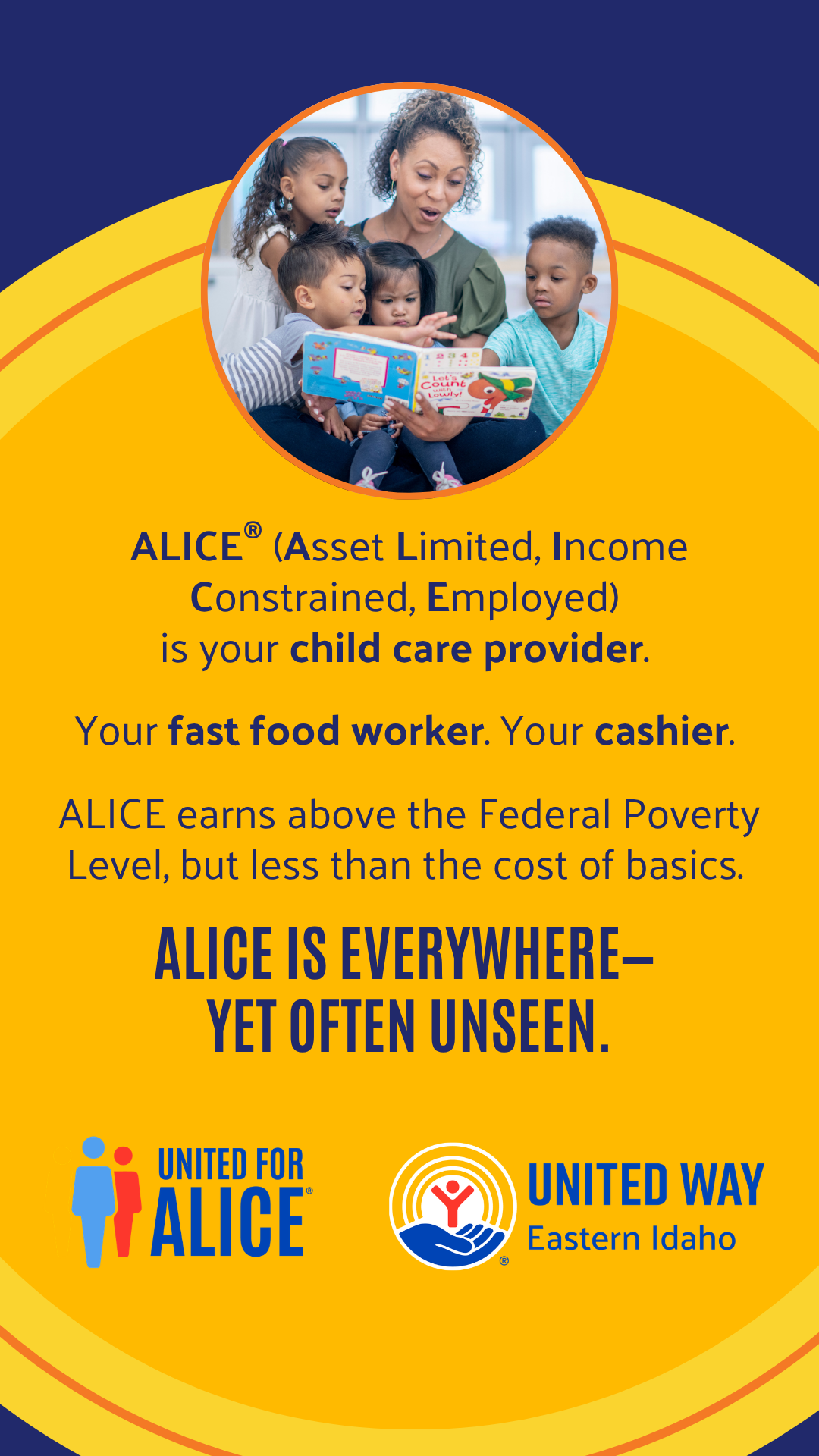
ALICE is the child care workers, home health aides and cashiers, the essential workers–those working low-wage jobs, with little or no savings and one emergency from poverty. They make more than the Federal Poverty Level but less than what's needed to survive in the modern economy.
What’s making it even harder? The cost of household basics has been rising over time. The ALICE Essentials Index tracks the change in the cost of basics, which families can’t skip — housing, child care, food, transportation, health care, and technology.
But this new data is more than a snapshot of hardship. It’s a tool for action. When we understand what families are really facing, we can make better decisions as neighbors, employers, policymakers, and local leaders to build stronger communities where all households can thrive.
Start by exploring the data at UnitedForALICE.org/Idaho to learn more about ALICE families in our community.
.png)
.png)
Updated Idaho ALICE Report
United for ALICE conducts high-quality research to understand financial hardship across the U.S. The scope goes from as broad as the whole nation and as narrow as individual counties in each of their partner states. They used to report their findings every two years but are now updating their reports yearly. The latest report was published in June 2026. The data for Idaho shows that for eastern Idaho, 38,336 households were living below the ALICE threshold.